A compact steel-string designed for low-effort activation, clarity, and close control.
The Lirica brings together structural design and acoustic control to shape how the instrument behaves under the hands. It responds with very little input and remains stable within a controlled dynamic range, allowing you to articulate and shape sound without requiring force.
Rather than emphasizing dynamic range, the Lirica is designed for precision and immediacy in playing. It remains clear and readable at low to moderate input, making it particularly suited to composition, recording, and intimate playing contexts.
The result is an instrument that feels direct, controlled, and highly responsive — offering precision, nuance, and presence even at low levels of energy.
Cantilevered neck
The neck is inserted directly into the upper bout of the soundboard, without a traditional heel block.
This configuration improves the distribution of forces between neck and body, contributing to structural balance and consistency of response, particularly in the upper register.
The result is a more even behaviour across the fretboard, combined with full access to the highest positions and simplified maintenance.
The asymmetric upper port modifies how acoustic energy is radiated from the soundboard monopole.
It supports low-frequency response while maintaining clarity, avoiding the typical accumulation and loss of definition associated with standard soundhole behaviour.
At the same time, it provides a more direct listening field for the player and facilitates microphone placement in recording situations.
The ETS system allows precise adjustment of the main resonances after assembly.
Rather than leaving their placement to chance, the resonances are positioned and maintained in relation to the target behaviour, reducing irregularities and limiting the appearance of wolf notes.
This ensures a stable response across the fretboard, with consistent sustain and controlled interaction between notes.
Each instrument includes an individual specification sheet with frequency response data, allowing the evolution of the instrument to be monitored and, if needed, re-adjusted over time.
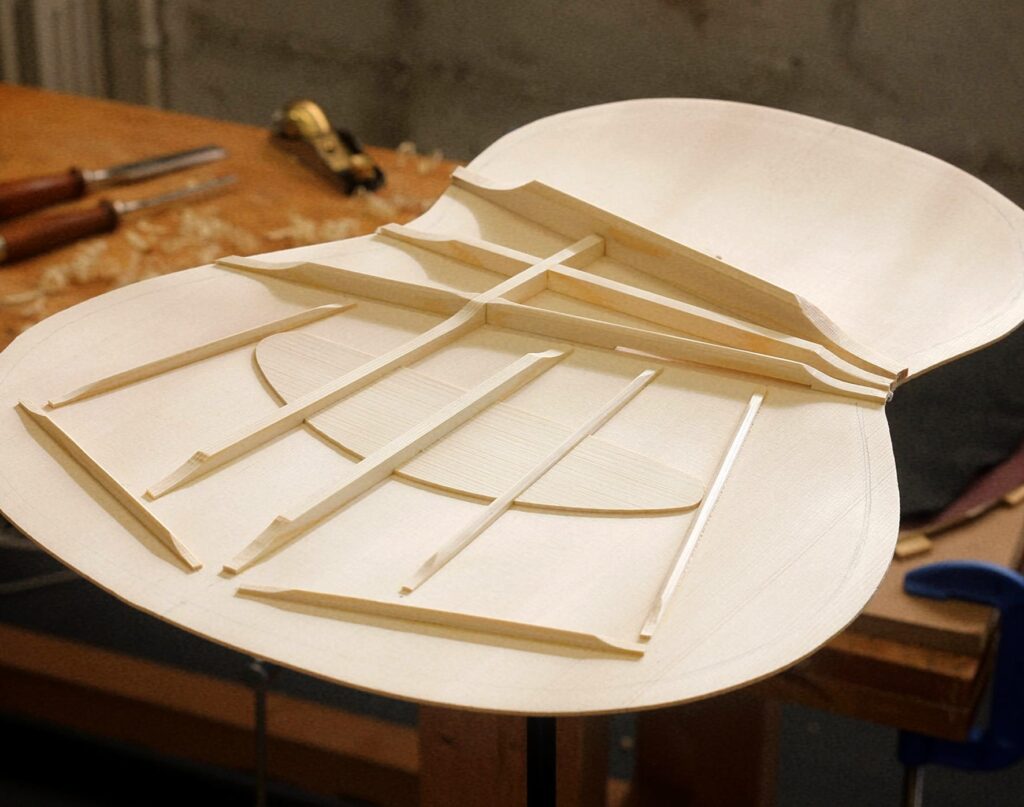
The T-Fan bracing system controls mass, stiffness, and modal distribution in relation to the intended response.
It results in a low equivalent mass of the soundboard (around 58 grams) and a mobility value around 16 (s/kg × 10⁻³), supporting a fast and controlled reaction to input.
The structure is designed to maintain stability across dynamic variation, ensuring that the instrument remains consistent under both light and stronger playing.
Each instrument is adjusted at system level during the build to align its resonant behaviour, avoiding irregularities and ensuring continuity across the full range.
The frequency response of the Lirica shows a controlled placement of the main resonances. The presence of dipoles and tripoles between 200 Hz and 1 kHz reflects a well-developed overtone structure and a responsive behaviour at low levels of input.
This distribution of resonances supports a precise and controlled behaviour across the fretboard, allowing the instrument to remain clear and readable under light to moderate playing conditions.